What Does Hope Look Like Now?
And why we must remain hopeful.

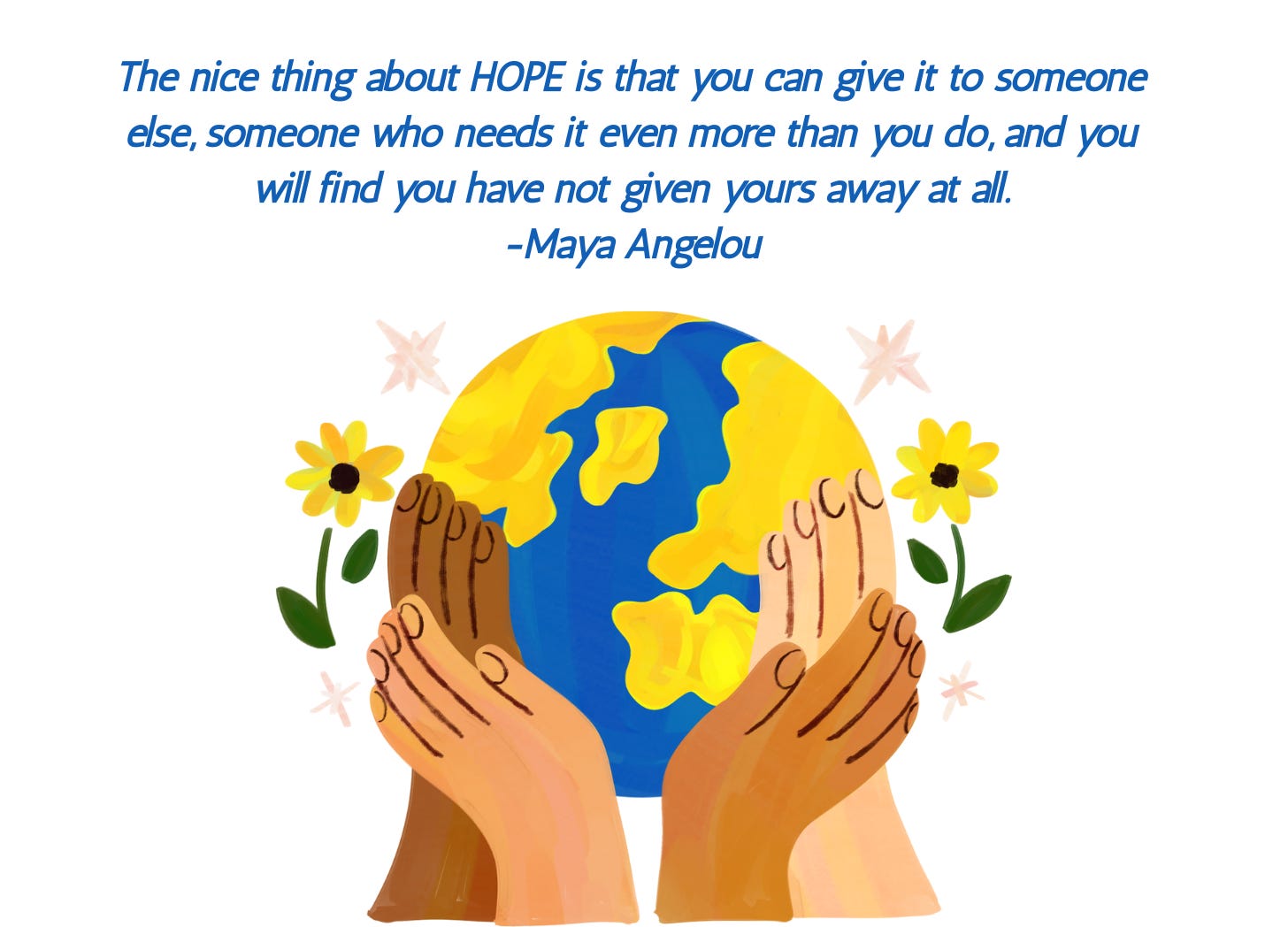
NOTE: This is the third article in my “action-oriented hope” series. If you’d like to read them in order, check out Hope is my Resistance and Hope: Not for the Faint of Heart.
Several folks kindly connected with me about my “hope” series, concerned that what I’m saying means not acting on, but just wishing for better in response to what we’re experiencing here in the U.S. That’s definitely not what I’m proposing with my articles. In fact, I believe the opposite to be true. Hope enables us to act. Believing in a positive outcome gives us the power to act in a way that defies the brutality of our current situation. Hope strengthens us to push on even when they want us to feel hopeless. Our children and grandchildren need to be immersed in the hope of a better future, even if it takes the our generation and the next to implement change.
Now, feeling the need to explain this has caused me to jump a bit ahead of myself for what I planned to write. I currently practice steps of hoping that work for me most days. But rest assured, days exist where I need to push myself hard to be hopeful. Having these steps helps me avoid hopelessness.
STEP 1 - Wait in Hope
I thought all of your steps promote action? Waiting is action. Just being quiet and not reactively leaping forward definitely requires deliberate action. Waiting often means contemplation, meditation, prayer or whatever other word you like to use. I spent the first part of 2025 focusing on waiting in hope. It felt like the only thing I could do as our country spiraled into chaos. Spending time in nature, just sitting quietly with others who need that silence as much as I do, and reminding myself of the goodness in life because there is goodness to be found. Waiting in hope also strengthened me for the next steps.
However, waiting in hope isn’t a one and done step. I still practice it daily because it allows me to gather up the good in my spirit and lean into hope rather than anger. It encourages me to be kind and aware of those who need me to hope for them. Hoping for positive changes, and yet recognizing that we will most likely go through great challenges before we experience those changes. My friend, Michele, recently said that the U.S. will never go back to way it was before, and that’s not necessarily a bad thing. I think many of us, specifically privileged white folks, recognize more, now than ever, that this hasn’t been the greatest country for brown and black folks, for the LGBTQ + community, for the impoverished, for our Vets, etc. For too long, we’ve been comfortable with the status quo. Part of my daily waiting in hope focuses on how this could all change through the brutality we’re battling now. Hoping for better than we used to be. Hoping for hate and ugliness to be replaced by love and humanity. Although I know there will always be hateful entities and people, combatting with love requires hope - that conviction and belief in the better.
It’s tempting to skip waiting in hope. I think our culture has taught us that not immediately acting demonstrates weakness. I disagree - the ability to wait in hope and to use that time to mentally prepare ourselves for the next step exhibits wisdom and strength. For many people, waiting in hope makes it possible for them to move on to step 2.
STEP 2 - Plan in Hope
I’ve recently become a big fan of your weirdo friend because her experience provides something I didn’t have in my toolbox. Her wisdom builds my hope. Her words direct me as I plan in hope. It’s brutal watching our fellow humans being kidnapped and killed by ICE. It’s brutal watching children pulled away from their parents and placed in detention centers. Most people care for animals in shelters better than these children are being treated. I also struggle with the distortions of history trying to be forced on our children and future generations. I know, in reality, this trauma will greatly impact their entire lives, all in the name of hatred and racism. Even as I write this, I want to just scream and act out against their abusers. But in reality, those emotions won’t serve me, those children or their families well. So what is the point of hoping when we feel so incapable of stopping this brutality and hate?
Planning in hope involves educating ourselves (again, I cannot recommend your weirdo friend highly enough), developing plans for non-violent responses, and exploring how we can bring hope into our communities via food resources, medical care, protection, etc. especially with the arrival of additional ICE. Most U.S. cities already have a contingency of ICE operatives, but at this time, many of them aren’t yet attacking protesters and people of color in the way they are in Minneapolis. That doesn’t mean they won’t. In fact, depending on how we respond to Minneapolis, they’ll head to other major sanctuary cities to do harm. With that being said, it’s vital that we plan in hope now.
In my own town (I live in a blue spot in a red state), ICE did spend a weekend with our highway patrol, who actually pulled over people of color and then stepped aside to let ICE move in on the vehicles. Most people weren’t aware it was happening, but those who knew came out to video and protest. It was only a matter of days before ICE stopped that intense operation, but they continue to target folks on a lesser level. ICE isn’t new. And in my state, we cannot count on our governor or other police forces to protect us. In fact, almost every police force in our state has contracted to support ICE operations. ICE has been targeting people that they label as “criminal illegal aliens” since they were put into action in 2003. I think most of us, particularly white folks, felt like they were just going after terrorists. Yet in 2024, 55,740 non-criminal immigrants were arrested by ICE. While their tactics and numbers now are much more extreme, ICE has been arresting non-criminal immigrants for decades.
Knowing all of that, what can we do to plan in hope in the present and for the future?
Our greatest hope lies in our care and protection of our fellow humans. While my heart wants to fly to Minneapolis and support those beautiful people, in reality, I would probably be more of a burden than a help. It’s better for me to support them financially (Note: If you’d like to support folks in Minnesota, visit Stand with Minnesota and discover many ways to help.) and working locally, letting them know they’re not alone. Planning locally for ICE coming to my town allows me to build up hope in a better plan. None of us should assume they won’t arrive, and all of us need to plan. Minneapolis is providing the example, and we must respond in hope. They’re showing us how to best operate in many ways. They’re demonstrating bravery, love and hope in and for their fellow humans. Would they be bothering if they didn’t hope for a positive outcome? That outcome may not happen today or tomorrow, but imagine if the folks in Minneapolis just shut themselves up in their homes and allowed ICE to do their damage without recourse. Every time they protest in Minneapolis, ICE operatives are distracted from harming those they hunt. It takes a tremendous amount of hope and bravery to care. So much hope in making things less frightening for children. So much hope is shopping for families who can’t leave their homes and housing children whose parents have been taken.
STEP 3 - Act in Hope
Action-oriented hope possesses power that anger alone can’t touch. Revenge movies became all the rage for a while, particularly those where family members are killed or kidnapped. But the energy it takes to sustain anger that long isn’t realistic. Even if you feel angry enough to act on it for an extended period of time, sustained anger damages you physically, emotionally and psychologically. Don’t get me wrong, anger is essential. It signals danger; it keeps us focused for a short period of time often motivating us to act. But it also promotes impulsivity, thrusts aside rational thought, and negatively affects our decision-making abilities.
Look at ICE operatives - many of them seem fearful, even fully armed and roaming in packs. They always appear angry, even when they’re not attacking. They make poor decisions and those decisions will determine the course of their lives and ours. They need weapons to feel strong. They’re constantly told that protesters and immigrants are the enemy so they’ll stay angry. Some are even lying to their families about their jobs. They claim to wear masks for protection, but for many, I believe those masks cover shame. So anger, even based on lies, allows them to maintain their facade. But it’s not sustainable for many of them. Before long, recruiting ICE operatives will be an even bigger issue than it is now as we watch them melt down due to mental and physical health issues. We are already experiencing the consequences of sustained anger as we see many of them unable to control their impulses. As in war, the body and mind can only bear so much trauma, even if you’re the cause of that trauma.
Action-oriented hope allows us to respond with intelligence and creativity, rather than irrational reacting. Some of the most effective responses to ICE reflect high levels of creativity, from costumes to singing to dancing. When we remember that we’re all humans, we’re less likely to react in anger. When we work to resolve problems with an expectation of a better outcome, at some point, we’re more likely to protest without getting injured, participate in food and supply drives, care for those most in need, and bring a level of sanity that appears to be disappearing during these chaotic days. Even when interacting with folks in tremendous fear of ICE, we can offer action-oriented hope to provide peace and help them make decisions beyond a place of fear or anger.
Acting in hope means every time we email or call a representative, we’re believing they’ll hear us. Of course, individual voices sound quiet, but collectively, we can get through. Every time we donate resources and time to make our community healthier and safer, we’re acting in hope of better for our community. We’re also modeling for other communities and spreading hope.
I’ve met a number of community organizers lately, and it’s quite interesting how calm they remain in the face of chaos. They operate with action-oriented hope, believing that what they’re doing today not only affects other people’s hopefulness for the moment, but also for the future.
Hope isn’t an emotion or a wish, it’s pro-active, believing that we’re doing today can make tomorrow better.
They want us to feel hopeless. They want us to feel like we have no way out of this. They want us to give up our fellow humans and hide in our homes. Hope is the opposite of what they want.
Hope is my strength.
Hope is how I maintain my compassion.
Hope is my resistance.
Hoping you are healthy and strong as we work together against the darkness. Hope you are able to find peace and love in each day, if only for moments.
As hope builds with community, I’d love to hear how hope affects your life and your actions.